
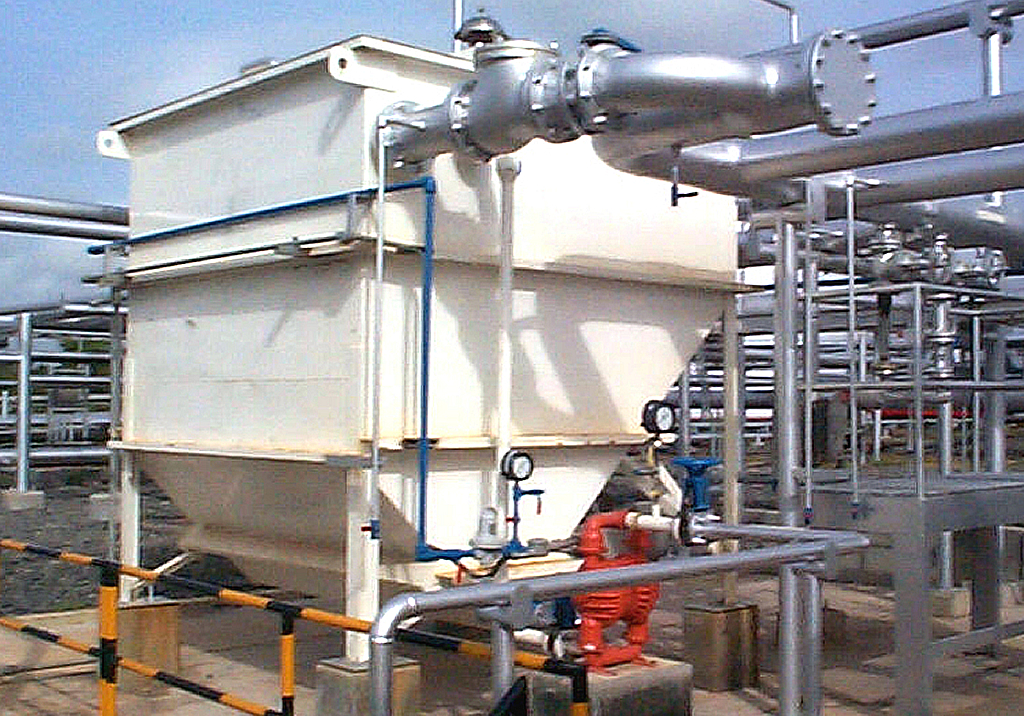
The Best Option in Primary Treatment of Produced Water.
The corrugated plates separator is the first option to consider in the gravity separation of oily waters, particularly in effluents with a low presence of suspended solids, such as produced waters. Its lack of moving parts and greater surface area in a smaller volume make it the most compact and efficient selection for oil and water separation.
Its residence time is approximately one-fifth of that of a conventional API separator, whose gravity-separation sizing follows API Publication 421 – Design and Operation of Oil-Water Separators.
Operation of a Corrugated Plates Separator Tank
Oily water enters the CPS corrugated plates separator unit towards the inlet compartment, which in turn acts as a pre-sedimentation chamber for suspended solids. This chamber reduces the velocity of the incoming effluent and directs it toward the plates pack inlet. Here, it contacts large oil droplets exiting the pack in an upward flow. The oily effluent, containing small droplets and remaining solid particles, then enters the plate pack, where the pack establishes a laminar flow.
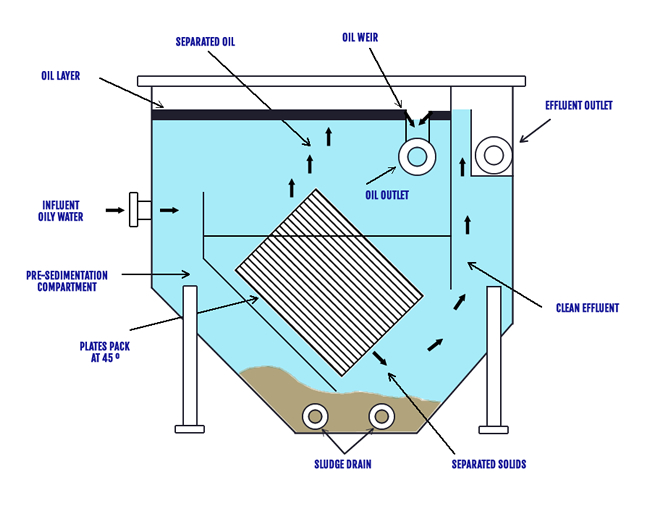
Corrugated Plates Separator Pack
The Corrugated Plate pack acts as the heart of the equipment. It increases the surface area by placing plates in parallel, which distributes the total flow into multiple parallel channels and facilitates the coalescence and separation of the finest oil droplets from the effluent. While typical plate spacing measures 3/4″, the system allows for greater spacing to accommodate effluents that create plugging from high solids concentrations. The system distributes the effluent flow evenly between each plate channel and directs it downward at a 45º inclination.
The oil in each of the plate channels rises toward the ridges of the corrugated plate and flows counterflow toward the package inlet, then rises to the surface of the tank. The solids, on the other hand, settle in the valleys of the plates and flow down along with the effluent to settle at the bottom of the tank.
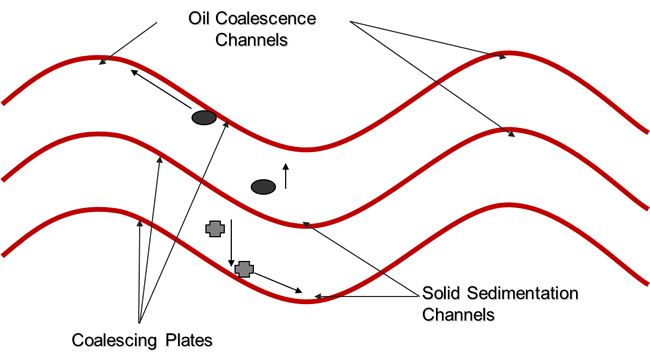
CORRUGATED PLATES MATERIALS
The selection of plate materials is made based on the effluent temperature. Fiberglass is the option for effluent temperatures below 45ºC and stainless steel for higher temperatures.
Other Applications
Among the most common applications of corrugated plate separators are the following:
- Produced Water
- Ballast or Bilge Water
- Runoff Water
- Equipment Washing Water.
Corrugated Plates Standard Models List
| Model | Flow GPM | Flow m3/hr | Dimensions (m) L x W x H | Peso Vacío kg | Peso Lleno kg |
|---|---|---|---|---|---|
| SWSCPS010 | 10 | 2 | 1.35 x 0.91 x 1.17 | 341 | 636 |
| SWSCPS060 | 60 | 14 | 2.43 x 1.42 x 2.13 | 867 | 5,448 |
| SWSCPS125 | 125 | 28 | 3.05 x 1.42 x 2.29 | 1,816 | 8,626 |
| SWSCPS250 | 250 | 57 | 3.4 × 1.42 x 2.82 | 2,225 | 12,530 |
| SWSCPS500 | 500 | 114 | 3.25 x 2.64 x 2.82 | 3,087 | 20,430 |
| SWSCPS750 | 750 | 170 | 3.61 x 3.86 x 2.82 | 5,448 | 31,962 |
| SWSCPS1000 | 1,000 | 227 | 4.83 x 2.67 x 3.66 | 6,356 | 40,406 |
| SWSCPS1500 | 1,500 | 341 | 4.8 x 3.86 x 3.66 | 9,216 | 59,020 |
| SWSCPS2500 | 2,500 | 568 | 4.8 x 6.30 x 3.66 | 15,845 | 76,272 |
More Info
Downloads
Corrugated Plates Separator Application Form
FAQ
A corrugated plates separator (CPI) is a gravity-based oil-water separator that uses packs of closely spaced corrugated plates to remove free oil and settleable solids from water. It’s the first option to consider for oily effluents with low suspended-solids content, such as produced water, and it relies on the density difference between oil and water (Stokes’ law).
Both rely on gravity, but a corrugated plates separator packs far more separation surface area into a smaller volume. Its residence time is roughly one-fifth that of a conventional API separator, so it delivers equivalent separation in a much more compact footprint and can capture finer oil droplets.
A corrugated plates separator is commonly designed to remove free-oil droplets down to around 60 microns — considerably finer than the ~150 microns typical of a conventional API separator. Removal efficiency depends on the density difference between oil and water, the effluent temperature, and its viscosity.
Plate material is chosen based on effluent temperature: fiberglass (FRP) for effluents below 45 °C and stainless steel for higher temperatures. Both resist the chemicals and abrasion common in oily wastewater, and because the unit has no moving parts, maintenance stays low.
They’re used wherever free oil must be removed from water — oil & gas produced water, refinery and petrochemical effluent, equipment and vehicle wash water, and general industrial wastewater pretreatment. They’re often installed upstream of a polishing stage such as DAF to meet final discharge limits.
No. Gravity separation only removes free, non-emulsified oil. Chemically or mechanically emulsified oil must first be broken with demulsifiers, then polished with a flotation stage (DAF/IGF) to reach low discharge limits such as 15 ppm.